
【单元导览】3 节课时演进图谱(点击展开)expand_more
- 语言进阶 (Language development · 第 1 课):
- 现代职场价值驱动与就业形态学术语料:从日常口语跨越至学术特质词;掌握现代劳动经济学核心语料(自主权、工时弹性、职业倦怠、离线权、产出导向考核、终身稳定性)。
- 词性转换与抽象名词化:掌握形容词向抽象名词的派生规律(autonomous ➔ autonomy, flexible ➔ flexibility, secure ➔ security),实现由“就人论事”向“制度与理念论辩”的文体升维。
- Task 1 六大图表要素与柱状图语言基石:系统掌握六大图表专有构成术语,并深入攻克静态柱状图“三梯队宏观聚类法”、跨柱倍差对比与柱状图微段落黄金三联公式。
- 应试核心技能 (Exam skills · 第 2 课):
- Task 1:审读与理解题干;六大行业办公形态柱状图宏观趋势提炼;四段式标杆范文 6 维解剖与逻辑提炼。
- Task 2:审读与理解题干;宏观把控四大底层立论任务;雅思官方 6 大题型四段式架构矩阵与首尾段/语法防雷前置速查;过劳治理对策展开三级递进逻辑链推演。
- 考场真题实战 (Exam practice · 第 3 课):
- Task 1 柱状图实战工坊:六大行业排班形态分布柱状图与 8.5+ 标杆范文精解(黄金第 2 段 Overview 法则)。
- Task 2 双边辩证大作文工坊:高薪稳定 vs 工作满意度与生活平衡 8.5+ 标杆范文精解(PEEL 辩证论证模型与闭环回扣)。
本课紧扣雅思学术写作大纲与 Band 7.0+ 语言精准度(LR & GRA)要求,系统夯实本单元学术语料与句法基石:
- 现代职场价值驱动学术词网 (Topic-Specific Lexical Network):彻底摒弃口语低分词,系统掌握 autonomous, flexible, creative, adaptable 等现代弹性与自主创新驱动词汇,以及 secure, stable, competitive, compliant 等传统稳定与科层竞争驱动词汇;
- 语法进阶与词性抽象名词化转换 (Nominalisation Mastery):熟练实现形容词向抽象名词的高阶派生(autonomous ➔ autonomy, flexible ➔ flexibility, secure ➔ security),以紧凑的名词短语替代松散从句,实现文体正规度升维;
- Task 1 六大图表要素与静态柱状图语言基石 (Visual Anatomy & Bar Chart Foundation):系统解构六大图表专有英文构成术语,并掌握静态柱状图“三梯队宏观聚类法”、柱体差值/倍数对比句式与微段落黄金三联公式,为第 2、3 课职场柱状图打下坚实底座。
一、 职场诉求与工作形态:从日常口语到学术表达 (Workplace Drivers & Professional Values)
【学习目标】
在雅思大作文(Task 2)中,考官经常考查关于“职业选择、远程办公、工作满意度与工作生活平衡(Work & Employment Dynamics)”的社会学与经济学议题。
许多考生在此类话题中最致命的失分陷阱是:习惯直接套用日常口语与情绪化闲聊(例如把追求稳定描述为 just want a safe job and not get fired,把自主办公描述为 hate being bossed around and like to do my own thing)。这种低幼口语会导致文体正规度(Register)严重失格,词汇多样性与精准度(Lexical Resource)往往被考官压制在 5.5~6.0 分档。
考官希望看到的,是考生能够运用客观、中立、精准的学术特质词汇(Academic Workplace Attributes)去理性探讨职业诉求与组织机制。
为此,我们首先来观察现代职业论坛中 4 位职场人士就“职场核心诉求与工作形态”展开的发言研讨。请观察讨论场景,并体会他们发言中展现的两种截然不同的价值取向:

(一) 从日常口语到 6.5+ 学术特质词的质变升级 (Spoken to Band 6.5+ Lexis Upgrades)
为什么在雅思大作文中不能直接搬用日常口语表达?
在雅思写作评分标准 (Band Descriptors) 中,考生要突破 5.5~6.0 的低分瓶颈、稳稳拿下 Band 6.5+ 的词汇得分(Lexical Resource, 简称 LR),有两项核心硬性门槛:
- 学术语域与文体规范 (Academic Register):大作文属于学术政论,严禁使用非正式的生活俚语(如 bossy, getting fired, doing your own thing),必须使用客观严谨的中立学术特质词;
- 高密度概念整合 (Lexical Condensation):高阶学术特质词能够将繁冗的口语从句(如 deciding how to organize my own tasks without someone watching over me)高度提炼为一个精准词汇(autonomous),成倍提升学术论辩的信息密度。
请对照下表,体会从日常口语跨越至官方评分标准认可的 6.5+ 核心学术特质词 的 1:1 质变升级图谱:
| 6.5+ 学术特质词 (Academic Lexis) | 口语低分表达 (Low-Register Spoken) | 权威释义 (Cambridge Academic Definition) | 考场高分学术例句 (Band 6.5+ In-Context Example) |
|---|---|---|---|
| autonomous | deciding how to work / being own boss | Independent and having the power to make decisions for yourself | Modern knowledge workers thrive in an autonomous environment where results precede physical presence. |
| flexible | choosing your own hours | Able to change or be changed easily according to the situation | Offering flexible working arrangements significantly improves employee retention among dual-earner families. |
| creative | coming up with original ideas | Producing or using original and unusual ideas | Routine administrative tasks stifle creative problem-solving across corporate research departments. |
| adaptable | quick at handling changes | Able to adjust easily to new conditions and dynamic work demands | Employees who remain adaptable to technological disruption face far lower risks of long-term redundancy. |
| secure | not worrying about losing job | Free from danger or the risk of sudden unemployment | A secure civil service position remains highly attractive during periods of broader economic volatility. |
| stable | steady and unchanging | Firmly established and not likely to move or change unpredictably | Generational shifts have challenged the assumption that workers desire a stable lifetime tenure with one firm. |
| competitive | paying more / wanting to beat rivals | Wanting very much to win or be more successful than other enterprises | Attracting top talent necessitates offering competitive remuneration packages alongside mental health support. |
| compliant | doing what the boss says | Willing to obey formal rules and corporate protocols without protest | Traditional manufacturing environments typically demand compliant adherence to standardized operating procedures. |
二、 抽象名词化与词性转换 (Nominalisation Mastery)
【提分要点】
精准掌握上述学术特质形容词,你已稳稳迈过了 Band 6.5 的词汇门槛(摆脱了 5.5 分生活口语的纠缠)。
而若想在此基础上进一步向 7.0+ 进阶冲刺,考官最看重的一项高阶语言武器就是——抽象名词化(Nominalisation)!
为什么突破 6.5+ 必须掌握抽象名词化?
雅思考官在大作文评分时,极为看重文章是在“讨论抽象机制、组织制度与社会规律(Discussing ideas and issues)”,还是仅仅在“就人论人、描述具体个人琐事(Describing individuals)”:
- 5.5~6.0 分低幼口语描述(局限于具体个体): Because workers want to be flexible and decide their hours, they feel happier. (句式松散、视角狭隘)
- 6.5~7.0+ 抽象名词化论述(跃升至组织学高度): Greater schedule flexibility and professional autonomy foster heightened job satisfaction. (以抽象名词作为句子核心主语,庄重严密、信息密度极高)
标杆示范金句 (Examiner Model Sentence):
"Job security and career stability remain paramount concerns for workers facing automated economic displacement."(面对自动化带来的失业挑战,工作保障与职业稳定性依然是劳动者的首要关切。)
| 形容词 (Adjective) | 抽象名词 (Abstract Noun) | 常见词缀演变规则 | 高频易错警示与辨析 |
|---|---|---|---|
| autonomous | autonomy | -ous ➔ -y | 不可数名词,核心搭配 grant autonomy, professional autonomy;切勿杜撰 autonomism。 |
| flexible | flexibility | -ble ➔ -bility | 不可数名词,核心搭配 schedule flexibility, operational flexibility;切勿写 flexibleness。 |
| secure | security | -ure ➔ -urity | 不可数名词,核心搭配 job security, financial security;指有价证券时才用复数 securities。 |
| stable | stability | -ble ➔ -bility | 不可数名词,核心搭配 career stability, economic stability;切勿混淆 stabilization(稳定化进程)。 |
| creative | creativity | -ive ➔ -ivity | 不可数名词,指“创新能力”;切勿与 creation(具体创造物/造物)混用。 |
| adaptable | adaptability | -able ➔ -ability | 不可数名词,核心搭配 adaptability to changing technologies;切勿混淆 adaptation(生物适应/改编本)。 |
| competitive | competitiveness / competition | -ive ➔ -iveness / -ition | competitiveness 侧重主体的“竞争实力与优势”;competition 侧重外部“市场竞争活动”。 |
| compliant | compliance | -ant ➔ -ance | 核心搭配 compliance with corporate regulations, regulatory compliance;切勿错拼为 -ence。 |
【避坑警示】
务必确保在写作中使用正确的词性。在雅思词汇运用中,将形容词误用作主语(如 Autonomous is important ✕ ➔ Autonomy is important ✓)将直接导致词汇(LR)与语法(GRA)双重失分!
三、 现代职场与工作生活平衡高阶语料矩阵 (Essential Lexicon for Work & Employment)
【知识增补】
在雅思考场面对 Task 1(如不同行业弹性办公与传统坐班人数分布图)与 Task 2(探讨高薪稳定 vs 工作满意度、过度加班治理对策)时,仅靠基础特质词远远无法展开具有深度的经济与管理学论证。
考官在评判 Task Response (TR 7.0+)与 Lexical Resource (LR 7.0+)时,高度青睐考生能否调动劳动经济学(Labor Economics)与现代职场健康前沿的专业语料。研读并熟记以下三大维度高阶学术语料:
(一) 就业形态与工作模式 (Employment Models & Modalities)
| 核心学术概念 (Key Term) | 中文精准界定 | 常用学术搭配 (Collocations) | 考场高分示范语境 (Band 6.5+ Model Context) |
|---|---|---|---|
| hybrid work model | 混合办公模式 | adopt a hybrid work model; balance in-office and remote days | Adopting a hybrid work model enables employees to combine collaborative office interaction with focused home-based tasks. |
| work-life equilibrium / work-life balance | 工作与生活的良性平衡 | maintain a healthy equilibrium; disrupt work-life boundaries | Failure to maintain a sustainable work-life equilibrium inevitably triggers occupational exhaustion and diminished productivity. |
| career mobility vs. tenure stability | 职业流动性 vs 长期在职稳定性 | lateral career mobility; lifetime employment stability | Younger cohorts increasingly prioritize career mobility and skill acquisition over traditional lifetime tenure with a single enterprise. |
| presenteeism vs. results-oriented | 伪出勤主义(磨洋工)vs 产出导向考核 | unproductive presenteeism; output-focused evaluation | Corporate cultures that equate long hours with dedication foster toxic presenteeism rather than genuine intellectual output. |
(二) 职场健康与政策治理工具 (Workplace Welfare & Institutional Governance)
| 政策工具术语 (Policy Lexicon) | 中文内涵 | 机制与作用路径 (Mechanism) | 考场高分示范句 (Model Sentence) |
|---|---|---|---|
| statutory right to disconnect | 法定离线权 | 法律禁止雇主在非工作时段强行要求员工查收邮件或接听电话 | Enacting a statutory right to disconnect prevents constant digital intrusion into employees' private recovery time. |
| four-day workweek trials | 四天工作制试点 | 在薪酬不变前提下缩短每周法定工时,依靠效率提升弥补时长 | Pilot programs for a four-day workweek have demonstrated that reduced hours can enhance focus without diminishing overall output. |
| occupational burnout mitigation | 职业倦怠缓解机制 | 设立心理辅导咨询、强制休假与项目负荷审计 | Corporations must implement proactive burnout mitigation strategies to curb escalating healthcare costs and talent turnover. |
| meritocratic career progression | 唯能绩晋升考核机制 | 摒弃论资排辈与人情纽带,以客观业绩里程碑作为晋升准绳 | Transparent promotional criteria ensure that meritocratic career progression replaces opaque managerial favoritism. |
(三) 雅思大作文 Band 6.5+ 学术论辩金句库 (Examiner Model Argumentation Templates)
- 句型① 论证内在满意度超越纯物质报酬 (Prioritizing Intrinsic Fulfilment):
"While a competitive salary provides indispensable financial stability, occupational satisfaction and personal fulfilment remain the definitive arbiters of long-term professional longevity." - 句型② 批判无休止加班与伪出勤文化 (Critiquing Overwork & Presenteeism):
"Unchecked presenteeism and chronic overtime culture not only precipitate severe psychological burnout, but also paradoxically erode cognitive acuity and organizational productivity." - 句型③ 倡导制度性弹性与离线保护 (Advocating Institutional Flexibility):
"Policymakers and corporate leaders should establish progressive frameworks that combine statutory disconnection rights with schedule flexibility, thereby dismantling structural overwork from within modern workplaces."
四、 Task 1 六大学术图表要素拆解与专有术语 (Figures and Tables Anatomy)
【考情通识】
在学术类 Task 1 写作中,题目要求对图表所呈现的信息进行客观归纳总结。考生应当熟练掌握不同图表形式(折线图、柱状图、饼图、表格、流程图与地图)及其代表的信息特征。学术小作文的核心评分关键在于“提炼主要特征与对比(Summarise the main features and make comparisons)”,切忌机械汇报图表中的每一个微观数据。
在雅思学术类(Academic)Task 1 写作中,题干均以视觉图表呈现。熟悉不同图表的标准英文术语及其核心部件名称,是精准提取数据并写出地道引言的前提。
请认真研读以下 Task 1 六大经典学术图表构成部件全景解构图:

| 图表类型 (Visual Type) | 核心考查属性 (Primary Function) | 核心部件专有学术词汇 (Key Components) | 考场写作高分表达 |
|---|---|---|---|
| 1. Line graph (折线图) | 展示跨时序的动态走势 (Trends over time) | horizontal axis (横轴/时间轴) vertical axis (纵轴/数值轴) | Here the horizontal axis represents time and the vertical axis represents the changing variable. |
| 2. Bar chart (柱状图) | 进行多类别横向对比 (Comparisons between categories) | column / bar (矩形柱条) cluster (多柱组合簇) | Each column (or bar) represents one category of data. |
| 3. Pie chart (饼图) | 展示整体与各组成部分占比 (Proportions of a whole) | segment (扇区) proportion / share (份额) | Each segment indicates a percentage of the whole. |
| 4. Table (表格) | 提供精准详实的多维度数值分类 (Categorised data) | rows (横行) columns (竖列) | This table contains three horizontal rows and four vertical columns of figures. |
| 5. Flowchart (流程图) | 展示制作工序、运作机制或自然生命循环 (Sequential processes & natural cycles) | stage / step / phase (阶段/步骤) arrows (流向箭头) | Each box represents one distinct stage in the overall process. |
| 6. Map (地图) | 展示地理布局、设施规划或空间演变 (Geographical layout & developments) | geographical features (地理与设施要素) | The map illustrates the physical and geographical features of the town. |
五、 静态柱状图梯队聚类 (Grouping) 与极值倍差对比句法 (Bar Chart Categorisation & Tier Comparison)
【备考点拨】
在本单元第 2 课(Part 2)与第 3 课(Part 3)中,我们将连续迎战两道经典的职场与就业静态柱状图(Static Categorised Bar Charts)。许多考生在初次面对包含 6 个横轴类别的柱状图时,最容易犯下的致命错误就是“按横轴从左到右逐根柱子报数”(例如:First, flexibility is 84%. Second, security is 75%. Third, autonomy is 48%...),这种机械流水账不仅会让句式陷入极度同质化,更会导致 Task Achievement (TA) 与 Coherence & Cohesion (CC) 双双卡在 5.5 分。
为了彻底根治流水账,考官要求考生在动笔前先对柱状图的柱体高度进行“三梯队宏观聚类(Three-Tier Grouping)”,并运用高阶比较与倍数结构完成段内推进:
(一) 静态柱状图“三梯队聚类法”与职场核心诉求柱状图精析
请仔细观察下方与本课第一节职场特质词网紧密呼应的 Figure 1.2B 全球职场人士核心职业诉求调查柱状图 (2025):
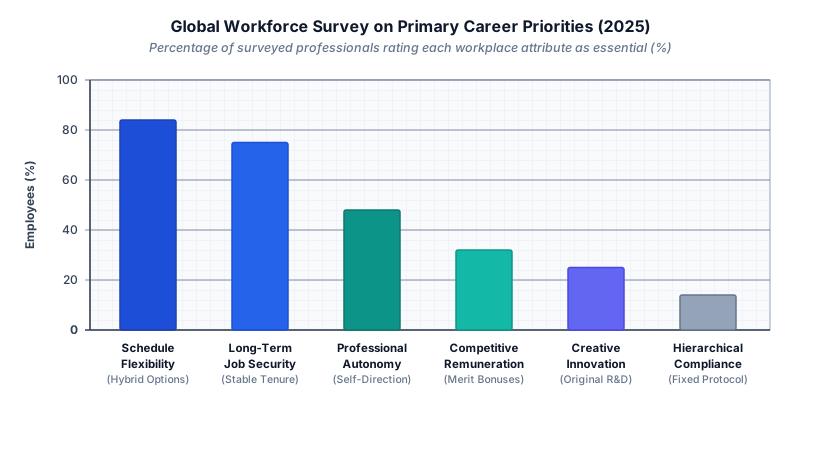
面对图中高低错落的 6 根矩形柱条(Columns / Bars),高分考官的审题视角绝不是孤立看 6 个数字,而是立即按柱体高度与职业属性切分为三大逻辑梯队:
| 柱体梯队划分 (Bar Tier) | 涵盖职场诉求类别 (Survey Categories) | 柱高数值 (%) | 宏观聚类特征与高阶转换词块 (Grouping & Lexical Upgrade) |
|---|---|---|---|
| 第一梯队:高位主导柱群 (Top-Tier Dominant Bars) | 1. Schedule Flexibility (Hybrid Options) 2. Long-Term Job Security (Stable Tenure) | 84% 75% | 双双突破四分之三水位线(well over four-fifths 与 precisely three-quarters),共同构成现代劳动者最看重的两大基石诉求。 |
| 第二梯队:中游腰部柱群 (Middle-Tier Moderate Bars) | 3. Professional Autonomy (Self-Direction) 4. Competitive Remuneration (Merit Bonuses) | 48% 32% | 处于中位过渡区间:专业自主权接近半数(nearly half),绩效薪酬激励略低于三分之一(just under a third)。 |
| 第三梯队:低谷尾部柱群 (Bottom-Tier Trailing Bars) | 5. Creative Innovation (Original R&D) 6. Hierarchical Compliance (Fixed Protocol) | 25% 14% | 居于全图垫底区间:创新研发占四分之一(exactly a quarter),而传统科层服从仅占极少数(a small minority of 14%,仅为榜首的六分之一)。 |
(二) 柱状图柱体高度对比、差值与倍数四大核心句式 (Bar Chart Comparison Formulas)
在完成三梯队聚类后,如何用精准地道的学术句法把不同高度的柱条串联起来?请熟练掌握以下柱状图四大黄金对比句式:
| 句法功能定位 | 柱状图核心句型公式 (Syntactic Formula) | 语法与介词搭配要点 | 结合 Figure 1.2B 的高分示范句 (Band 8.0+ Model) |
|---|---|---|---|
| 句式①:榜首与次席串联 (Top Two Bars Link) | Category A topped the chart at X%, followed closely by Category B at Y%. | 定点数值前统一用介词 at;用过去分词短语 , followed closely by... 一次性紧凑交代前两根最高柱条。 | Schedule flexibility topped the chart at 84%, followed closely by long-term job security at exactly three-quarters (75%). |
| 句式②:中游梯队并列报数 (Middle-Tier Pairing) | In the middle tier, C and D registered X% and Y% respectively. | 用 registered / recorded + 数值 + respectively 将两根中游柱条合并同句,避免拆成两个单薄短句。 | In the middle tier, professional autonomy and competitive bonuses registered 48% and 32% respectively. |
| 句式③:跨柱悬殊差值对比 (Margin & Gap Contrast) | A exceeded / outnumbered B by a substantial margin (X% versus Y%). | exceed 侧重比例/数额超越;outnumber 侧重可数人数超越;by a wide/substantial margin 表“以悬殊优势”。 | Professionals prioritizing schedule flexibility outnumbered those valuing strict compliance by a wide margin (84% versus 14%). |
| 句式④:首尾柱高几何倍数 (Multi-fold Disparity) | ..., which was six times as high as the figure for the lowest bar (Z%). | 当最高柱与最低柱呈整倍数关系(如 84% ÷ 14% = 6)时,用非限制性定语从句或分词 representing a sixfold disparity 拔高 TA 得分。 | Only 14% endorsed hierarchical compliance, representing a sixfold disparity compared with the top-ranked priority (84%). |
六、 柱状图微观段落写作黄金三联公式与综合演练 (Bar Chart Micro-Paragraph Writing)
面对单图或多类别静态柱状图,高分考官最推崇的微段落推进逻辑被称为“柱状图黄金三联公式 (The Bar Chart Golden Triad Formula)”:
- 第一联:宏观两极总揽句 (Macro Tendency):不罗列具体琐碎百分比,高度概括全图最高柱群(工作弹性与职业稳定)与最低柱群(传统科层服从)的两极分化态势;
- 第二联:高位与中游柱体梯队推进句 (High- & Middle-Tier Details):运用
topped the chart at..., followed by...及分式词块(three-quarters, nearly half),有条理地汇报第一、二梯队柱条; - 第三联:低谷反差与倍数收束句 (Trough & Multi-fold Contrast):运用强转折连接词(In stark contrast)引出垫底柱条,并点出首尾柱高之间的几何倍数差距(sixfold disparity)完美收束段落。